
American prisoners reunite 6 decades later
POWs unchain memories
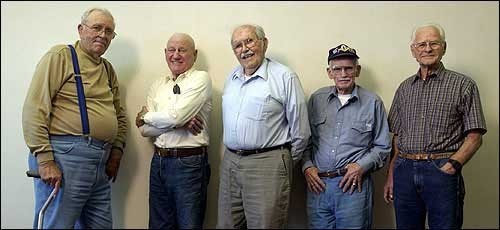
These U.S. military veterans met last week for a reunion in Kansas City, Mo. Now in their 80s, they were captured on Dec. 8, 1941, on Guam and spent the duration of World War II in Japanese prisons. All began their incarcerations at the Zentsuji Prison Camp. From left: Howard Ross, 86, Melbourne, Fla.; Harris Chuck, 86, Vista, Calif.; Donald Binns, 86, Lawrence; Richard Salsbury, 82, National City, Calif., and Robert Epperson, 84, Cottonwood, Calif.
Kansas City, Mo.? Brought together again by their uncommon wartime bond, seven retired U.S. Navy sailors and Marines, all in their 80s, were in a hotel outside Kansas City, Mo.
They spent World War II, from start to finish, 1941 to 1945, in Japanese prisoner of war camps.
They were captured when the Japanese invaded Guam on Dec. 8, 1941, the day after the attack on Pearl Harbor. After three and a half years of beatings, starvation, and otherwise gruesome conditions, they were liberated and sent back to the United States on Sept. 10, 1945.
Don Binns, 86, a former Lawrence mayor, city commissioner and Lawrence High School American government teacher, organized the annual reunion of the POWs. They’ve met at a hotel near Kansas City International Airport for the past 15 or 16 years. Nobody remembers exactly how long it’s been.
“Old minds,” somebody said.
A sword story
On a recent rainy Friday afternoon, Binns and some of his comrades were sitting in a tiny hotel room at the Lexington Suites Hotel.
They were telling stories that the intervening decades have made only slightly less painful or frightening.
“I was stripped of all my clothing, taken into a large room and put on my knees with my head down,” Binns said softly. “A Japanese captain pushed the edge of his sword down, against the back of my neck. He told me, in perfect English, that he would behead me if I didn’t tell where we’d hidden our weapons.”
Binns lied, saying there were no weapons.
He figured the UCLA graduate with the sword knew he was lying.
About the Authors
Their Stories
The prisoners were routinely tortured and beaten, usually at the whim of the guards. The captives’ daily rations consisted of two small bowls of watery soup and a portion of rice or barley, when it was made available. Their diets were supplemented by food they would steal at any opportunity.
There were no more questions, only silence and the weight of a sword at the base of his skull.
In the quiet room, Binns heard the sword slice through the air as it left his neck and heard it “swoosh” on its way down.
“For a minute I thought he’d actually cut my head off,” Binns recalled, laughing loudly. “Hell, my life even flashed in front of me.”
The small room filled with laughter.
‘One ironclad rule’
That reminded former Marine Howard Ross, Melbourne, Fla., of his sword story.
“A Japanese general on a white horse threatened to cut my head off because I splashed some water … he even drew his sword,” Ross said frowning, waving his arms over his head.
Retired Marine Harris Chuck, Vista, Calif., interrupted.
“I don’t think they could find a blade sharp enough to cut through that thick skull,” he said, landing a soft right hand to Ross’ shoulder.
At 86, Chuck, an ex-drill instructor and retired sergeant major with 30 years in the corps, looked like he still could be a handful.
While the stories continued at one end of the room, Binns talked about the group.
“We were never this close in camp,” he said. “Life there was tense, tempers flared, and we fought a hell of a lot.” He smiled and waved his finger in the air. “But we had one ironclad rule: You had to go outside to fight. You start swinging your arms in a small room with 28 people in it, and you’d soon have 28 pairs of arms going at each other.”
Slave labor
The camp Binns was describing was the Zentsuji Prison Camp on the southern tip of Japan. It was the first stop for all of the prisoners from Guam. Some, like Binns and Ross, stayed in Zentsuji for the war’s duration. Others were sent elsewhere.
Each of prisoner was used for slave labor. The harshest camps used prisoners to mine coal, haul iron ore and move steel. Americans in Zentsuji were used to load and unload rail cars using only their backs and arms to move bags of rice, salt and ores. The bags usually weighed in the 100- to 200-pound range.
Contact Me
Get In Touch
Do you have a story you want to share? Maybe an image to add? Contact me today, we are always accepting new historical content to share with future generations.